Keenan 411

Stop Telling Everyone What To Do

Sales Leaders – When times are tough, sales numbers aren’t being made and the outlook is bleak, stop telling everyone what to do. Stop yelling!

As sales leaders, we are notorious for demanding our sales people hit their numbers, threatening job losses for those who can’t get with the program. I’ve never understood why, it rarely works. When times are tough across your organization it’s no longer about the sales team. It’s about your sales leadership. Sales teams don’t fall apart all at once because everyone simultaneously decided to take break and ride the gravy train. When your organizations numbers are categorically down there is something seriously wrong that needs to be fixed and demanding the numbers are met or else, aint gonna fix it.

When the numbers aren’t there it’s time to be a leader. It’s time to start listening. It’s time to start assessing. It’s time to determine how to turn it around and fast and yelling isn’t the answer.

“The day soldiers stop bringing you their problems is the
day you have stopped leading them. They have either lost
confidence that you can help them or concluded that you
do not care. Either case is a failure of leadership.” – Colin Powell

“The commander in the field is always right and the
rear echelon is wrong, unless proved otherwise.” – Colin Powell

To turn things around, turn to your team. Meet with your traditional top performers. Get there insight on what is behind the decline. Meet with your top customers. Ask them their thoughts and why they are spending less. Find out what it would take to get them buying again. Engage your customers who have maintained or increased their spend. Find out what makes them different? Get to the root of the problem or problems. Triage the situation and then fix it. That is your job. If you can’t fix it then you know for sure your sales team can’t fix it.

Remember, when sales are up it’s because of your sales team. When sales are down, it’s because of you . . . so stop yelling.

Getting Real and Not Being Seen as Weak

Not too long ago I was invited to a National Sales Conference. It was your typical, yearly sales conference designed to rally the troops and set agenda for the coming year. What I remember most was the CEO’s presentation and the companies goal to grow 5% to 7%. Grow 5 to 7%? I remember asking myself what evidence did he have that allowed him and the company to believe they could grow at this rate? The banking crisis had already begun. Credit was already tight. The market had already fallen 30%. And most notably, these numbers represented similar growth patterns for the company during “good times”. I just couldn’t see how this organization believed they could grow at that rate, based on the current economic environment.

The truth is they couldn’t and they’re not. Since the conference, I’ve been told sales are down substantially, like almost every other company in America. Could this company have seen the size of this economic decline? I don’t think so. But they could have seen A decline. The just chose not to. They chose not to confront reality.

Nobody wants to hear the truth, especially when its bad. Getting real with what is happening within an organizations environment is the achilles heel of business. The pressure to perform is too great. It’s not OK to say we can’t do something. But, it should be. It’s considered a weakness to say something can’t be done. Saying something is unachievable or not likely labels you weak, not on board, or worse – incompetent. This is only true when the data doesn’t support it. However, when the data suggests something is improbable or not realistic confronting it is exactly what should be done. Had this company confronted the reality of the economy and their real capabilities they could have responded entirely different, thereby preserving profit and mitigating the losses.

Since the downturn in the economy I am hearing numerous stories of sales and business leaders demanding numbers of their teams to meet their goals regardless of what is truly realistic. This authoritative approach only kills moral as it continues to push and drive the organization toward unrealistic goals, employees become more frustrated with lack of success, which in turn drives even more dictatorial demands. A cycle is started.

What should be done? Confront Reality! Ram Charan, and Larry Bossidy’s book, by the same name talks about this very topic. Engage your team, assess what your truly capable of, understand what the economic environment will allow, be real in accepting the information, and set goals best on what you can do, not what you want to do or “NEED” to do. Getting real with your environment allows organizations to be more nimble, it allows them to capitalize on growth and mitigate decline. HINT; Sometimes decline is inevitable, pretending it isn’t doesn’t help. Accepting it, mitigating it and taking your lumps early is far less impacting than pretending it isn’t going to happen.

In our society, getting real is hard, especially if it’s bad news. We don’t like naysayers. We cast out those with “negative” information. We don’t like to hear it. But we need to.

In January of 09 how many companies projected a “LOSS” for 2009? I suspect not many. But, most should have. They just didn’t have the guts to state what was real.

It is best for companies to look at their world as it is, not as it was, or how they would like it to be! As I like to say: “It is what it is.” Accept it and then figure out what your going to do about it.

Go On, Provoke Your Customer

I just finished reading The Harvard Business Review’s article “In a Downturn, Provoke Your Customers” It’s good. I think it’s timely too, not because it’s filled with new, save the day advice, but because it reminds us there are many ways to sell. And, I do agree with the authors, economic times like these require us to understand as many different sales approaches as possible.

Although not innovative in it’s idea, Rick Page a Best Selling Author called this approach “Business Development” in this book Hope is Not a Strategy. Provoking your customer is a real and effective sales approach for sophisticated sales companies and their teams.

HBR describes Provocative Selling this way:

1) Identify a critical problem – so ominous that, even in a downturn, the company will find the money to address it.
2) Formulate a provocative view of the problem – a fresh perspective that frames the problem in a “jarring” new light.
3) Lodge you provocation with an executive who has the power to approve the solution you’re proposing. To win support, convey magnitude and intractability of the problem

The idea is to identify a problem in your customers environment they are unaware of. Create a powerful solution to the problem. Finally, educate your customer of the problem and of YOUR solution. The key, according to HBR, is to persuade customers that the solutions you bring to the table are not just nice, but essential.

All in all, it was a good article. There were things I like and things I didn’t.

What I liked:

-I found the article motivating, as it made you feel that in difficult times there are strategies that work.

-It did a good job of outlining the theoretical underpinnings of Provocative based selling. Provocative based selling works. It is compelling and strengthens the customer, vendor relationship

-It was Branded brilliantly. “Provocative Based Selling” is a catchy, “Sticky” phrase. It’s easy to remember and therefore easy to adopt. As I referenced earlier, Rick Page describes a very similar sales approach in his definition of Business Development, but without the sticky branding it is lost in his book.

-There were good supporting materials: tables, mini-case studies, graphs and educational how-to’s.

-HRB did a good job of emphasizing the sophistication level of provocative based selling. They acknowledged the role of Marketing, Services and other company wide resources required to successfully execute this approach. It is NOT an approach that can be easily accomplished by a lone sales guy or even a good pursuit team. Provocative based selling requires experienced analysts, cross functional teams, (finance, sales, marketing, and vertical experts).

- They do a good job of comparing provocative based selling to solutions selling and product bases selling. It is very different. The approach relies heavily on information about your customers, their business, and the industry than it does on YOUR product and it’s features or even it’s enablers.

What I didn’t like:

-I think HBR grossly underestimates the ability to implement provocative based selling into an organization. The traditional sales person does not have the business acumen, industry knowledge or financial wherewithal to sell this way. You can’t just drop provocative based selling into an organization and expect it to work. Training and support will be critical for most organizations.

-The length of the sales cycle is underestimated. Depending on when an organization chooses to measure the sales cycle, it can be the longest and most complex of the selling processes. Provocative based selling takes tremendous preparation, and pre-sales effort. The internal effort can be as large as the client side effort.

-The article assumes that once the critical problem has been identified and lodged with the customer the sale accelerates as the client will quickly buy from you. This assumption is based on the premise that customer’s won’t look to your competitors to see if they can solve the problem too. It is a bad assumption. Just because you found it doesn’t mean your competitors can’t solve it as well.

-I think they could have spent more time on emphasizing the importance of having a provocative product or solution. This seems obvious, however far too often organizations aren’t real with themselves. Identifying the critical business problem is just one aspect of the approach. It is critical for your organization to have a powerful offer that can deliver substantial impact and resolution to the problem. Not all companies have a solution like this. If they do, they are most likely already provocatively selling.

-Expanding on my last point, due to the substantial impact product has on the ability to provocatively sell, the HBR completely left out the importance of partnering with the product organization. In many cases, successfully executing on provocative based selling, new products or offers are required. And when new ones aren’t required, enhancements may be required. The Product Development and Product Marketing groups are CRITICAL to provocative based selling.

Provocative based selling is a real approach. It’s not fluff. It requires a sophisticated team of sales people, analysts, product developers, industry expertise and a committed organization. Getting it right isn’t easy. But if you do, it’s one of the best tools you can have in your bag.

Just one successful, provocative based selling win, can put you and your organization at the cool kids table within your clients organization for a VERY long time. It can make all the other sales process much easier.

If you think you can do it, go do it. Go on, provoke your customer. It’s always cooler at the cool kids table!

Pit Bulls, Nicer Than Golden Retrievers

Meet Betty, she is our new family dog. BigE brought her home as a Christmas surprise. She is a great dog. She is loving, fun, and a great companion to our 2 and 3 year old daughters. betty

Betty is an American Pit Bull. Our neighbors are uneasy around her. One neighbor, rather than call us or bring her to us, called the police and animal control when, at 4 months old, she snuck under the fence and was playing in the lot next to our house. A neighbor challenged our responsibility as parents for getting “such a dog”. Another neighbor regularly jokingly asks; “When does this dog start killing people” Betty makes many of our neighbors uneasy and nervous.

Betty is harmless. She is amazing with our girls. She is the sweetest dog my wife says she has ever had.

It just doesn’t matter, she is a Pit Bull and Pit Bulls have a terrible brand. To most people they are dangerous dogs. They are killers.

What is interesting about the American Pit Bull brand is it isn’t consistent with the facts. The fact’s are American Pit Bulls are great dogs. American Pit Bulls were one of the most popular breeds in America at the turn of the 20th century. During World War I American Pit Bulls were a symbol of Patriotism. They appeared LIFE Magazine and movies. I’m sure you remember Petey, of the little Rascals. He was an American Pit Bull.

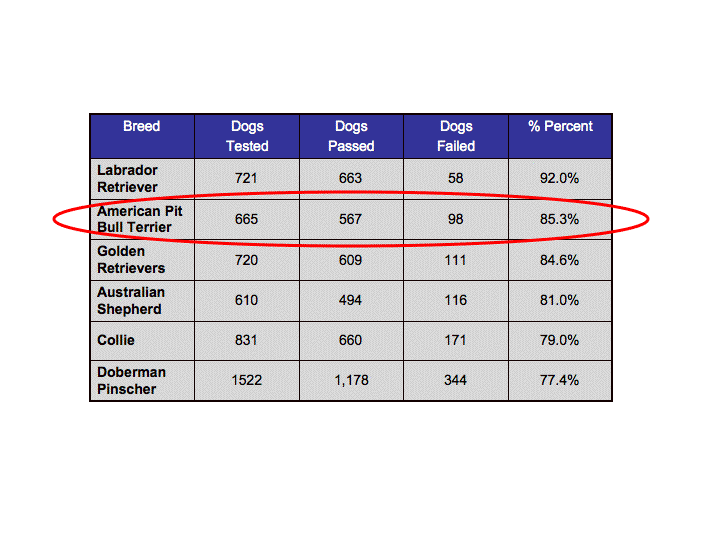
American Pit Bulls have great tempers and make great pets. The American Temperament Testing Society has tested over 27000 dogs for reactions to strangers, novel noises and sights and unusual footing. In addition, the dogs self-protective behavior and potential to be aggressive are assessed. Of the 27000 dogs tested, 81.5% have passed. Some breeds do better than others. The American Pit Bull rated higher than the over all average and out performed breeds more normally associated with being “good” family dogs including: Collies, (Yup Lassie), Australian Shepherds, and Golden Retrievers with an 85.3% passing rate.

temperament-test

Brand is a powerful thing. Brand measures perception. Brand isn’t a representation of reality or truth. Brand is what we think regardless of the facts. Getting stuck with a poor brand or doing things that negatively impact your brand can have dire consequences.

In today’s world of social media managing your Brand could not be more important. Doing nothing is not an option. Know who you are and what you do. Be clear and specific in the messages you send and deliver the messages regularly. Actively use Social Media tools and engage with others in Social Media with the same interests.

Soon online branding will be more important than your resume. Employers, clients, and partners will determine your value and your brand based on your online content, your relationships and your interactions. We are able to manage our Brands more now than ever possible. This means we can also direct our brands and ensure that what people think is exactly who we are.

American Pit Bulls are great dogs, unfortunately their brand says other wise. What does your brand say about you?

Sunday Morning Blog

How is an A-Player defined? This is just one of the great questions answered in Auren Hoffman’s cool blog Summation.

Auren hits you with quick, insightful posts that get you thinking. It’s great Sunday morning reading

Be Quick About It

The decisions you make dictate success or failure. Therefore, if they’re not irreversible make em quick. If you make a mistake, you’ll learn more from the mistake than if you did nothing.

Ask Steve Blank: “Speed and Tempo” – Fearless Decision Making for Startups

I’m a ConnectSalesman

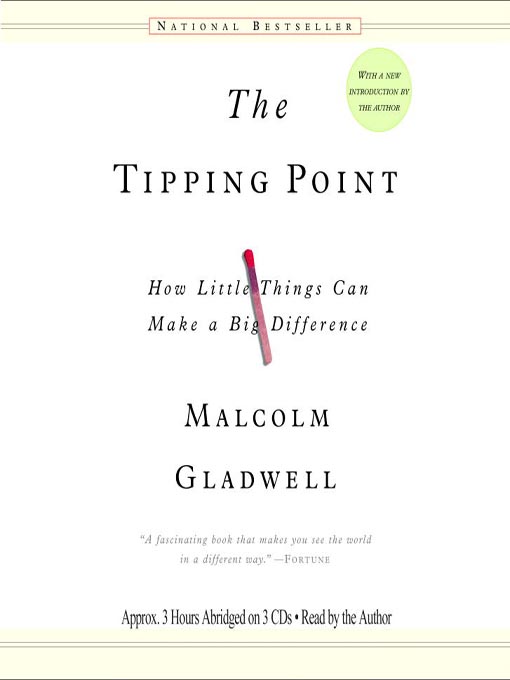
tippingpointDo you remember Malcolm Gladwells book, The Tipping Point? It was written almost 10 years ago. Amazingly prophetic. Written before Social Networks and the term “Viral” was ubiquitous, Gladwell gave us the roadmap on how ideas, trends and messages spread like “viruses” do.

Social Media, Web 2.0, Enterprise 2.0 have taken this idea to a new level. Twitter, Facebook, Myspace, Blogs, and the rest are high-powered engines accelerating Tipping Points.

In Gladwells world, I’ve come to realize I’m a ConnectSalesman. Gladwell says there are 3 types of people critical to a Tipping Point;

1) Connectors – People who move well between different types of people, groups or social casts. Connectors link the world. They have an uncanny knack of connecting different people from different social environments. Connectors will mix with CEO’s, SkateRats and Professors, they have no cultural or ideological boundaries.

2) Mavens-People who are “informational specialists”. Mavens collect information and live for sharing it. Mavens are “information brokers sharing and bartering what they know”

3) Salesmen – Salesman are the “persuaders”, charismatic negotiators who can persuade others.

In the Web2.0/Enterprise 2.0 world I’m a ConnectSalesman. I connect and I persuade. It’s a fun place to be.

As a ConnetSalesman I rely on all of you for my information. I trust and rely on you Mavens. Without Maven’s information Connectors and Salesmen are useless.

Social media is driving a fundamental change in our culture and I am having fun being a part of the process. What are you; a Maven, A Connector, a Salesmen or better yet: a MaveConnector?

Creativity Wins The Day

To sell in a tough economy you have to be creative. Being creative means doing things differently. It means being a contrarian and thinking outside of the box. When companies and people aren’t buying, relying on SOP (Standard Operating Procedure) will cause a slow death. Creativity is another word for innovation. To move your products, to get buyers attention, and to get your share of what is being spent you need to be innovative.

Leaders innovate, followers copy. During economic downturns there isn’t enough to go around. You have to be a leader, as there isn’t enough for the followers.

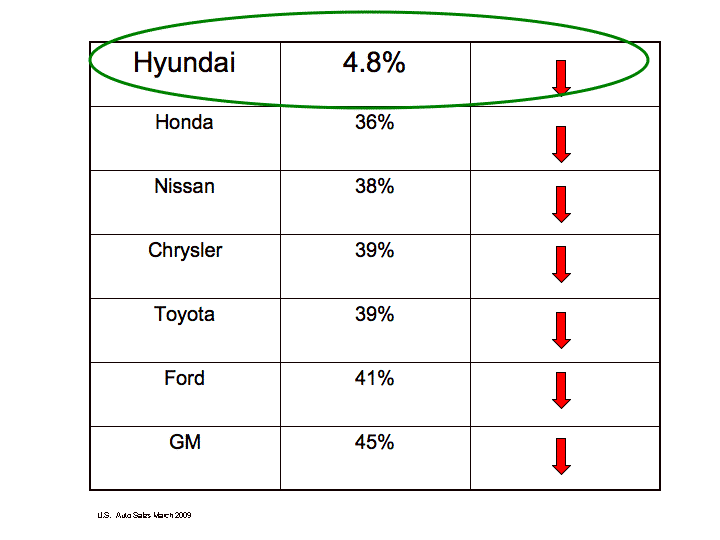
Hyundai is a leader. Early in 2009 they launched an innovative program offering to take back any new car if the owner lost their income. Hyundai understood the barrier to new car sales and came up with a creative way to combat it. Did it work? I’d say so. While the rest of the car industry tanked, Hyundai was able to stay almost flat.

carsales2

Not only did it work, Hyundai increase it’s U.S. market share by .5% in one month.

Score: Creativity – 1, Status Quo – 0

If you want to make it in sales during these tough times, you should be thinking differently. There is no way to be successful doing the same old things. Being creative means looking at the problem differently. It means asking different questions. Being creative accepts there are different ways of doing things. Many times it means taking a contrarian view. Being creative says, you recognize what you’ve normally done may not work and you need to make changes.

The most difficult part of being creative or innovative is it is different. It takes you out of your comfort zone. To many companies, and to many people being creative and taking contrarian views is risky and is putting your neck out there. What many fail to recognize is that in times like these your neck is already out there.

If you want to save your neck, get creative.

Oprah Needs To Be Consistent

On Friday April 17th Oprah jumped on Twitter. Within days she had almost a half million followers. Her Twitter coming out was a big deal. It was the 35th most popular search on the internet on Friday. And yes, Twitter benefited from the traditional Oprah effect, and got a big bump in traffic. Now that the “big splash” is over. Is Oprah going to use it?

. . . She should. But she is not.

Since Friday, Oprah has Twitted 15 times, of those, 12 came on Friday. Oprah has 420,000 followers. Yet, she follows only 10.

I hope this changes.

What makes Oprah, Oprah is her ability to connect with the average person. Her stories are heart felt and are human driven. Oprah is connected to people, her use of Twitter should extend this connection.

“Oprah” Twitter use should look more like this:

1) She should follow everyone who follows her.
2) She should assign someone to read her followers Twits everyday. (it’s unrealistic to expect her to personally read them all)
3) She should personally reply to the most compelling Twits
4) She should RT (ReTweet) at least 3 times a day
5) and she should Tweet regularly, about personal and professional things

If there were ever a perfect tool for Oprah, Twitter is it. Twitter fits perfect into Oprah’s brand. It connects her to the heart of her audience. It allows her to tap into the pulse of her followers, getting a view into their everyday lives like never before. It would extend the Oprah effect to blog posts, and Twits giving exposure to causes or stories that may have been lost. Oprah could have the same “effect” on Twitter as she does her show, but 10 times as fast. The ability for Oprah and her organization to positively impact peoples lives is increased exponentially.

It’s consistent for Ashton Kutcher to have 1 million followers and only follow 90. He isn’t about the people. Oprah’s different. Her brand is connecting, her brand is the human element. It’s not OK for her to only have 10 followers.

I hope Oprah and those closest to her see this. Twitter is a medium she could use to change peoples lives. But, to do it she has to be consistent with her brand, and right now she’s not being consistent.

Capturing The Invisible

the-invisible-man I had a great conversation the other day with Tim Young, CEO and Founder of Socialcast about Enterprise 2.0. During the conversation Tim talked about, what he calls, invisible and visible conversations. Invisible conversations are water cooler conversations, the conversations in our heads, the conversations that aren’t traditionally visible to an organization. I really liked the way he described it. I think there is value in capturing the invisible conversation.

We use Yammer at my company. Yammer, like Socialcast is a micro-blogging tool for the enterprise, similar to Twitter. About month ago, I Yammered about heading to NYC for a partner meeting. Before I got into the meeting, I had 3 replies asking if I needed anything and offering help. At the end of the meeting I Yammered the outcome as I was getting on a plane home. When I landed, there were 4 replies to my Yammer. The V.P. of product, and a cast of supporting folks had read my Yammer and had started developing the response and the strategy I needed to respond to the partner. It was amazing! Traditionally, it would have taken me several hours in calls and emails, with days of planning to collect the appropriate players, and formulate a response. By capturing the invisible conversation it was done in hours, on it’s own.

Yammer, Socialcast and other Enterprise 2.0 applications capture the invisible. Conversations that once occurred in our heads, with friends during casual phone calls, or while walking through a convention hall are now becoming visible and this visibility has value.

Enterprise 2.0 and tools such as Socialcast and Yammer put new information on the table. They flush out information normally hidden deep within our networks and casual conversations and allow companies to capitalize on that knowledge base. They speed the flow of information and allow for faster decision making. They can make companies more agile.

Agile companies that make better decisions perform better and performance is something you can measure. Can you capture the invisible? If you can’t, you should. There is value in it.

Keep Up With Me:


Categories

  • Asset of The Future (24)
  • Business Performance (118)
  • Career Development (33)
  • Customer Service (38)
  • Economy (10)
  • Enterprise 2.0 (22)
  • Entrepreneur (16)
  • Hiring/Firing (22)
  • Leadership (99)
  • Marketing (17)
  • My Reading Quotes (8)
  • Personal Brand (27)
  • Personal Development (74)
  • Politics (12)
  • Random (47)
  • Sales Process (70)
  • Skiing (5)
  • Strategy (2)
  • Sunday Morning Blog (18)
  • TalkShoe Events (5)
  • Technology and Products (7)
  • The Chase (103)
  • To the Community (1)
  • Uncategorized (63)
  • Web 2.0/Social Networking (76)
  • What I Think! (131)