Keenan 411

Who To Hire?

I got my first “real” job when I was 27. It was at the Chamber of Commerce. I was selling Chamber memberships. It was then that I knew I could sell. In my first year I broke every sales record they had had. I liked the Chamber, but I knew I couldn’t keep selling Chamber memberships forever. I was bored. Being 27 with only one year of selling experience, I didn’t have the resume for much of anything else. But, I knew I could sell.

About 11 months into the Chamber job, a well dressed, articulate gentleman walked into the Chamber interested in becoming a member. His name was Richard and he represented an IT consulting firm from Minnesota opening a branch in Denver. We sat down and I did what I did. I sold him. Part of my sale, even as a green kid with no experience, was to ask questions. In our meeting I learned what IT or technology was. It was 1997 and the IT industry was blowing up. I wanted to be a part of it. At the end of our meeting I asked him if they were hiring and he said yes. I said I want in.

With one years selling experience, no knowledge of the IT industry or how to sell in it, I didn’t even know what Y2K was at the time, I asked to be considered. Richard said he was impressed with me, but that I just didn’t have the experience, but that he would introduce me to the General Manager of the new Branch.

A month later, Mike the General Manager came to Denver. We met, and talked. I sold him on the benefits of the Chamber and why they needed to be at the level of membership they were and I gave him the VIP tour and presentation. At the end, the conversation turned to me. Mike said: “I understand you are interested in working for us.”

I said; “Yes.”

Mike was an approachable guy. You couldn’t help but like him. He was disarming and drew people to him. Mike looked at me and explained in a very considerate way that although he was impressed with me I lacked the experience he needed. He shared how he needed someone who could hit the ground running and drive revenue quickly and that once he found that person he would consider me. I looked at Mike and asked him a couple of questions. I asked him if he had found that person yet? He said no. I asked him if he had a pipeline of potential candidates. He said no again. I then said, “Mike, I understand your situation however I can sell. Everyday that goes by that you haven’t hired somebody is another day that I’ve learned more, become better and be making you money.” I said; “If you can’t find someone fast enough you will have lost that time I could have come up to speed and been delivering for you.” I then said; “I challenge you to find that person soon.”

I remember Mike smiling at me, giving me a nod of approval and saying he understood and that once he found that person and the time was right he would reach out to me.

Two weeks later I get a call from Mike. It went something like this. “You son of a bitch. I can’t get you challenging me out of your head. Let’s talk.”

I became a top producer at this company. After my first year I was the number one sales person at the Branch and was voted partner after my second year. Few people would have had the guts that Mike had. Everything on paper said no. But it’s not the paper that does the job. Thanks Mike, I owe you one.

Hire talent, smarts, passion, energy, and drive, the rest will take care of itself.

Why Do Your Employees Work For You?

Why do your employees get up and come into to work everyday? What drives them to make the commute, to miss family events, and to commit to YOU. I get why they work, but why for you? Do you know why?

A friend of mine and I were talking the other day about the difficult economy and it’s impact on employee moral. He predicted a mass migration in his company as soon as the job market improves.

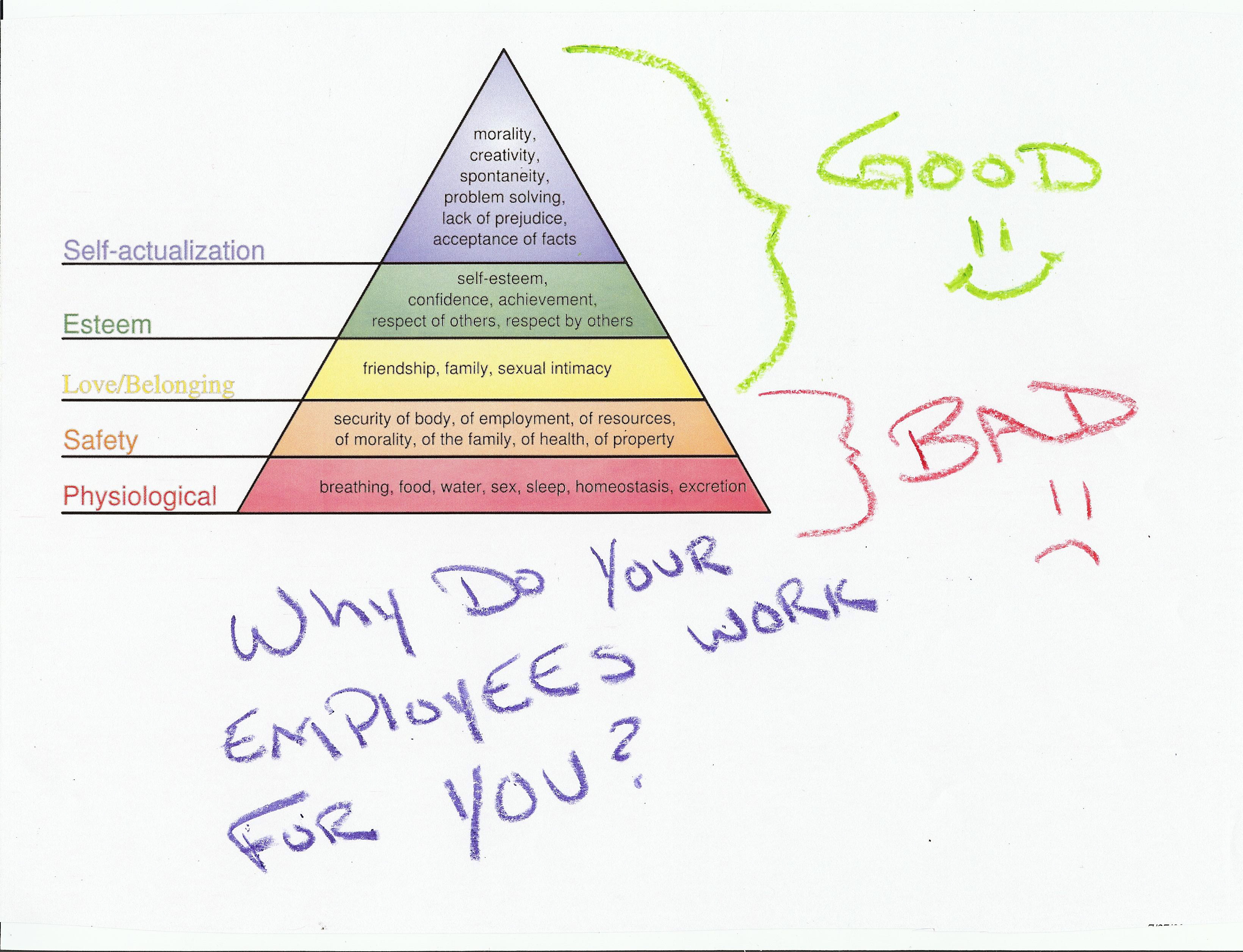
Why? Companies are making a lot of poor decisions, which is creating terrible working environments. People are still getting paid, but they are finding their work environment brutal. I tend to agree with him. In down times companies tend to lose focus on employee moral. They ask for more than they give. They show little loyalty and politics rules. When this happens, the only thing keeping their employee from exiting, is they have no where else to go. They feel trapped. Trapped by Maslow’s hierarchy of needs. They are in the safety hierarchy, trying to keep from falling into the physiological one. Things aren’t good if your there.

scan0002

Tough times at work find people in the safety zone trying to hang on and protect what they have. Unfortunately, it’s not enough. I think Maslow’s needs is true in the work place. Once the economy improves people will start to look elsewhere. People want to believe they are part of something bigger, that they belong. Layoffs, and budget cuts from up above don’t make people feel as if the are part of something or belong. They feel like leaves in the wind.

Once people feel they belong to something bigger, that they are part of something special, they want to contribute and be recognized for their contributions. This is where esteem comes in. Finally, they want to realize self-actualization. They want to leverage creativity to drive innovation, they want to have spontaneity, and more. People aren’t happy with just a job. They want to be a part of something. They want to help improve it and be recognized for it and they want to have the freedom to push the envelope. As choice comes back, employees will look to move up Maslows chart and if your company can’t provide it, they will leave.

What are people getting from your organization? Why do they work for you? If money and security are the answer be prepared. As things turnaround, you will find yourself hiring not because your growing, but because everyone is leaving.

Why do you work were you do?

What Really Motivates Sales People

You hear it all the time, Sales people are “coin operated”. Sales people are motivated by money. I’ve meet managers often who look for sales people motivated by money. They say; get your sales people spending, buying those new cars, and big houses. Get them hooked, and you’ll keep them motivated. I don’t buy this and never have. I WON’T hire a money motivated sales person or manager.

Money doesn’t motivate me and I won’t hire someone is motivated by money. Money is an incentive and shouldn’t be a motivator. Anyone who is motivated by money can only go so far. Tiger Woods wouldn’t be Tiger if he is motivated by money. He has more money than he can spend in a lifetime, literally. Tiger is motivated by accomplishment, desire to the best ever, and the challenge of cementing his legacy. Successful people aren’t motivated by money.

In a recent post, I asked what motivates sales people and shared what it is about selling that motivates me. The post created a lot of discussion on LinkedIn (if you can’t see because you are not a member of this group I’m sorry, but feel free to join. I’m hoping Disqus can find a way to bring those comments in as well.) Based on the discussion my assessment is fairly accurate. It’s not money. Rewards was a common theme. I think rewards is more about recognition than money. Only two people said money, the rest talked about accomplishment. Here are a couple of comments from the discussion.

“pat on back and recognition” - Raj Peesa

“Being able to accomplish a breakthrough sale and being seeing as someone who can achieve the impossible for others is my motivation. Money is nice but self-satisfaction, and peer recongnition, is the inner motivators. Of course a nice dollar bonus makes it easier to celebrate my success.” -Rich Delaney

“Great article, the chance to be a fixer and enhance the customer’s life is a great thrill. When all cylinders fire, there is no better feeling!” -Tom Tompson

“Thought provoking article. Often we assume that money is the great motivator, even when we know that for ourselves that is not true. For me, it’s recognition. A pat on the back, or a “job well done!” sends me back into the trenches smiling every time.”Valerie Thomison

Money motivates few people. Despite common misconceptions, sales people are not motivated by money. They, like others, are driven by accomplishment, self-actualization, challenges and recognition.

A perfect example is the introduction and proliferation of crowdsourcing which is proving that money is an incentive and not a motivator. People in many different areas give their time and knowledge for free for a chance to participate in something bigger than them, whether it be Wikkipedia, or IStockPhoto. Money incents behavior, it steers us in one direction or another however it doesn’t motivate us to keep going. Money is an incentive not a motivator.

Jim Ed Rice

My favorite baseball player Jim Rice is being inducted into the hall of fame today and I’m thriled. I loved Jim Rice. I was 10 years old in 1978, and during those formative kid baseball years Jim Rice was the most feared hitter in baseball, was black, and in Boston that was no small thing, and had my name, “Jim” ok, I had his name. He was my hero!

Everytime Jim Rice would come to the plate I would be glued to the radio or TV 38 hoping for the the big home run. I felt a certain connection to Jim Rice. I would be him in our neighborhood games. Jim Rice was everything to me.

My grandfather was a diehard Redsox fan. He would watch everygame on TV and when he couldn’t watch he would listen on the radio. It was through him, back in the 70′s, that I became part of Redsox Nation. It was through him, Jim Rice became my first hero.

Almost every kid in New England worshiped #14, Jim Rice. 85% of all kids in New England had a Jim Rice poster on their wall. We all copied his swing and argued who got to be him in lot games and went crazy when he hit one out of the “pahk”

I remember the year he signed one of the largest contracts in Baseball, 5 million dollars. Chump change by todays standards, but as far as I was concerened he was worth every penny.

I’m sure I’m like many today, if it weren’t for my affinity for my beloved childhood team I wouldn’t watch much baseball. I’ve never rooted for anyone to make the Hall of Fame. I find the baseball steroids scandal and the complete lack of accountability taken by commissioner Bud Selig deplorable. But for today, none of that will matter to me. My first idol, and childhood hero is being enshrined into Cooperstown and the Baseball Hall of Fame. I will be on the couch watching just like every other 40 year old guy who wore is number in Little League, copied his stance and had his poster on their wall.

It’s a big day for Jim. Both Jim’s!

What Motivates You?

Sales is a grind. It will get to the best of the best. The best however, have a secret motivation that keeps them going.

What keeps you going? What get’s you excited? What drives you? What pushes you to stay at the top of your game? What get’s you over the no’s? What moves you past the product failures, or implementation mishaps? What makes you want to work till midnight in order to close the deal? What is it that pushes you to spend hours researching alternative solutions? What motivates you?

For me it’s the problem. I see every sales opportunity as something to fix. I see someone who isn’t happy with their current situation. They’re not as competitive as they would like to be. They are spending more money than they want to. Their people are burning countless hours on unnecessary tasks. They want more of something, less of something or they want something and they just don’t know what it is. To me, every sale is a problem looking to be fixed. Fixing problems is what I do. I was the kid who loved the corny logic riddles that were so popular. I dig the creativity required to solve problems. I thrive on the fix!

Great sales people are motivated by something unique. They are driven by something that comes from inside. That something is the core to their success and they know it.

What motivates you?

Is There A Future in Enterprise Micro-Blogging?

I have been a BIG fan of enterprise micro-blogging for the enterprise. Think Twitter for businesses. We use enterprise micro-blogging tool Yammer at Avaya and it’s been a great tool for collaboration and interaction, especially for an international company with a large virtual workforce. I use it everyday. It’s part of my work flow.

I expect micro-blogging within enterprises will be as common place as IM and email with in the next 5 years. Companies won’t be able to run their businesses with out them. (why? is a different post) Micro-Blogging for business is here to stay.

Despite my optimistic outlook for the platform. I think the space is in trouble. There are too many players; Yammer, SocialText, SocialCast, Rypple, Obayoo and more. Here is a list of the top ten. Beyond there being too many players, the barrier to entry is too low. It’s too easy for new players to enter the space. This is evident based on the large number of existing players so early in the game. There isn’t enough room in the space to support so many companies. The business models are too similar. There is little differentiation.

Adding to the pressure to survive, the pricing model has been pushed to zero by SocialCast who announced a freemium model for unlimited users with full administrative control. Add all these up and it’s hard to see how anymore than one, and maybe two of the players can make it. Even then, I’m having trouble seeing anyone make it due to the freemium model with out a substantial paying option.

If this isn’t enough to crush this budding industry, then the launch of Microsoft’s Sharepoint 2010 due out the end of this year and Google Wave due out next year will be. Sharepoint 2010 is expected to have a substantial number of Web 2.0 tools attached, including a micro-blogging tool. Although not traditionally considered an enterprise software company, Google Wave, in conjunction with Google Docs, and Google Voice are a compelling suite of tools for small to midsized business. The introduction of Sharepoint 2010 and Google Wave make it difficult for IT departments to justify supporting a one off platform for one purpose. There isn’t a significant enough value in the current micro-blogging tools to support their one off use, when you have the same feature already integrated with your existing collaboration, communication tools.

Not too long ago I traded emails with Fred Wilson of Union Square Ventures about how Twitter could make money in the enterprise. He emphatically stated this was not a direction Twitter was going. I see why. Microsoft owns the desktop, companies like Cisco, Avaya and IBM could quickly add it to their Unified Communications platforms, Google Wave is attractive to small business, the business model has been pushed to free, and it’s a crowded field.

There is no future for the pioneers of enterprise micro-blogging. A lucky one or two will be bought within the next 18 months. The rest . . . RIP.

The good news, micro-blogging is here to stay and for that I am very excited.

Hard Work is Unreasonable

chickenwork

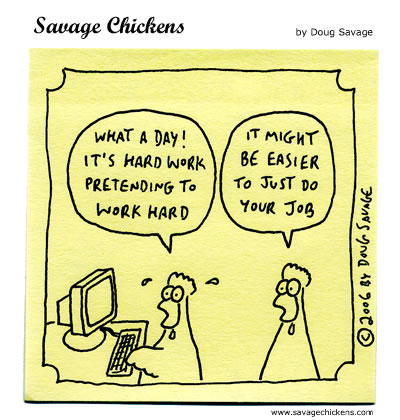
We live in an odd society.  We worship the successful, yet vilify their path.  Being successful and at the top of your profession takes hard work.  It takes the type of hard work most people call unreasonable and it is unreasonable.

It’s absolutely unreasonable to work has hard as Tiger Woods, or cellist Yo Yo Ma. After each major tournament round Tiger Woods hits as many as a 1000 balls on the range.  That’s after he’s just played a round of golf.  Tigers dad made him hit ten, 10ft putts in a row before he could quit.  (I’ve tried this, after 3 hours I gave up).   Michael Phelps spends over 40 hours a week in the pool.  This DOESN’T include working out and his non pool training.  Lawyers looking to become partner can routinely bill 80 hours a week.  It takes unreasonably hard work to be the best.

Hard work has become cliche.  I don’t think most people can truly comprehend the concept of real hard work.  The work required for the lifestyle most people want has too often been labeled unreasonable.  It’s unreasonable to work on the weekends.  It’s unreasonable to work on vacation.  It’s unreasonable to sit at a piano for 8 hours straight.  It’s unreasonable to practice for 12 hours a day 6 days a week.  It’s unreasonable to be on the road 6 days a week for a year.   It’s unreasonable to have to work that hard.   As a society we’ve come to expect it is unreasonable to work hard.  I agree.  It is unreasonable.

However, working unreasonably hard, creates unreasonable salaries and wealth.  Tiger Woods could never spend the amount of money he’s made to date.  His wealth is unreasonable for a person to have but it’s commiserate with his unreasonable work effort.  Reasonable effort gets your a reasonable salary.  No effort gets you no salary.  Substantial effort gets you a substantial salary.  Unreasonable work effort gets you unreasonable reward.

The next time you are faced with an unreasonable work load don’t do it. You’re right it is unreasonable.  Just remember, you get what you work for.

When Asking, Be Prepared

I’m often asked for my opinion.   The requests can range from reviewing business plans or ideas, to career support, to feedback on a podcast or sales literature.  It seems the requests have increased a little lately.   Not sure why.

I like helping people.  I am a big fan of feedback and search it out for myself all the time.  So, given the chance to pay it back, I normally do.  I can’t always help out, but when I do, there are a couple of things I require.  First, don’t expect me to put in more work than you.  If you have something you want me to read, an idea you want my opinion on or your looking for feedback, I expect you to have done at least 10 times more work than your asking me to do.  Don’t expect me to do the work for you.  It’s your work.  Second, expect real and honest feedback.  If you’re looking for validation, I’m not your guy.  Your Mom can do that better I ever could.  Third, allow me to work it into my schedule.  I like to get back to people as soon as possible, but It’s not always possible.  If you need something immediately, don’t count on me.   Next, expect to be challenged.  Challenging people is the most valuable support you can give.  Challenging people stretches them, it gets them out of their comfort zone.  It forces them to see things differently.  If you ask for my help, expect to be challenged and pushed.  Finally, tell me exactly what it is you want, what your doing, and what your goal is.  I don’t have time to guess.  Tell me what the purpose of the effort is, what your trying to accomplish and why it’s important.  I need context.  Without context, feedback is useless.  Don’t make me guess.  I’m a bad guesser.

In return, I will take my time and give it all of my attention.  I will take notes, ask questions, make suggestions, offer insight and do my best to add value.  If I can’t, I will tell you.  I can’t and won’t waste your time.

6 Ways To Get More Out of Your Sales Team

You are no better than your team. A basketball coach can’t play the game he can only get his/her team to play it better. Like a basketball coach sales leaders need to get their team to play better. A sales leader may THINK they can do it, however that kind of thinking is will doom them to failure.

A leaders job is to scale, not do the work. Leaders are supposed to get more out the group than the individual. It’s about the sum of the parts. One of the key ways for leaders to do this is to actually give a shit about the team.

6 Ways to show you give a shit:

1) Be visible – Don’t be seen only when you need something or asking for help. Be seen, and be visible. Don’t just show up and disappear.
2) Get to know your team - Focus on more than just revenue and pipeline. Get to know their strengths and weaknesses, their career aspirations, and who they are as people. Learn what motivates them and why. Don’t ACT as if you give a shit, actually do.
3) Know EXACTLY what your team does – Know what their day looks like and what processes they have to employ to do their job. Far too often leaders don’t understand what it is their team has to do to actually do their jobs. This a problem. Know what it’s like to walk in your teams shoes. (You might learn, you are a problem not a benefit)
4) Ask questions – Don’t tell your team what to do. Ask them what they think should be done. Help them process and come up with the answer on their own. If your telling your team what to do and how to do it, your doing their job. Don’t do their job.
5) Share - Be open with communication, keep the team abreast of everything that is going on; share ideas, information, thoughts, concerns and experiences. Share stories of success and failure. Sharing keeps the team motivated and engaged.
6) Be accessible – Be approachable, and available at all times. Make sure your team knows where you are, that you are available to them and that it is safe to engage you. If they don’t feel safe with you, it’s over.

Great sales people don’t always make great sales leaders. The ones that do understand the above. Focus on the team.  Leaders win or lose because of the team not because of them.

Confuse Us, Lose Us

gijoe
The new GI Joe movie is coming out and I’m not going to see it. Even though I’ve seen the previews, I can’t tell you what it’s about. This is because, I’m still trying to figure out why it’s called GI Joe.

The producers of the movie broke one of the golden rules of selling. They confused the sale. The new GI Joe is nothing like the GI Joe I remember. The GI Joe I remember was a hard, man’s man, army dude. He was the working guys hero. He wore camouflage, had a full beard, nappy hair and had a Kung-Fu grip. GI Joe was a bad ass! When I was a kid, he was my favorite doll next to Evil Knievel. I had this helicopter. It was awesome.

The new GI Joe is just confusing. He’s blonde, wears space suits, uses technological gadgets and has a crew with him. I don’t get it. This isn’t any GI Joe I remember. Where is the nappy headed GI Joe, I was convinced was black, with the Kung-Fu grip?

Bringing back old characters from generations past is cool. But not when you only bring back the name. Don’t confuse the sale. Remakes work because they capitalize on nostalgia. They tap dormant emotional connections. They find that place in our memory and our hearts we forgot existed. They bring our childhood back. And when done right we reward the studios for their efforts. Ironman, Superman with Christopher Reeves, StarTrek (all of them), are a few that stayed true and brought us back.

If you’re going to remake a movie, or bring an old character back to life, remember why they captured our hearts the first time and bring that back. It’s not the name that captured us, it’s who they were, it’s what they stood for, and it’s what the meant to us. Anything short of that is a cheap imitation. And just like back then if it wasn’t the real thing we didn’t want it.

No matter what your selling, confusing the sale only makes it harder as the buyer can’t understand what their going to get. And if they don’t know what their getting, they ain’t buying.

Keep Up With Me:


Categories

  • Asset of The Future (24)
  • Business Performance (118)
  • Career Development (33)
  • Customer Service (38)
  • Economy (10)
  • Enterprise 2.0 (22)
  • Entrepreneur (16)
  • Hiring/Firing (22)
  • Leadership (99)
  • Marketing (17)
  • My Reading Quotes (8)
  • Personal Brand (27)
  • Personal Development (74)
  • Politics (12)
  • Random (47)
  • Sales Process (70)
  • Skiing (5)
  • Strategy (2)
  • Sunday Morning Blog (18)
  • TalkShoe Events (5)
  • Technology and Products (7)
  • The Chase (103)
  • To the Community (1)
  • Uncategorized (63)
  • Web 2.0/Social Networking (76)
  • What I Think! (131)