Keenan 411

Jim Keenan is a Senior Sales Executive, Enterprise 2.0/Web 2.0 Connector, an Entrepreneur still trying to get it right, and a PSIA Certified Ski Instructor for Vail Resorts. Husband to Big E and father to four great kids. In a nut shell, I'm a Sales Guy. Life is good!

Do You Have the Guts?

Do You Have the Guts?

Do You Have the Guts?

As a leader . . .
Do you have the guts to hire a contrarian?
Do you have the guts to have people on the team who will disagree with you?
Do you have the guts to actively look for people more talented than you?
Do you have the guts to hire someone who will break the rules and deviate from process if it means winning? Will you celebrate them for doing it?
Do you have the guts to add the chaos that comes with spontaneity to your organization?
Do you have the guts to hire someone who will take risks and fail taking them?
Do you have the guts to have people on the team who think and act completely different than you?
Do you have the guts to have a subordinate tell you, you are wrong, EVEN if they are wrong?
Do you have the guts to let someone else pull all the strings?
Do you have the guts to get out of the way?
Do you have the guts to say, “I don’t know?” and ask the team for help?
Do you have the guts to be uncomfortable?
Do you have the guts?

I don’t care what your business card says. If you don’t have the guts, you aren’t a leader. You may be a good manager. You may be good with spread sheets and PowerPoint. You may be good at office politics, but you aren’t a leader.

It takes guts to be a leader. It takes real strength to be a leader. Unfortunately, these characteristics scare people, they scare companies. They disrupt the status quo. They challenge the systems. The create chaos. They create unpredictability. Corporations thrive on predictability and the status quo and unfortunately the cost to maintaining the status quo is the loss of great leaders.

Do you have the guts?

Sunday Morning Blog: Partners In Excellence

It’s been awhile since my last Sunday Morning Blog. I need to get better at this. However, if I don’t find a blog I like during the week, it’s fruitless to make one up. This week was easy as David Brock author of Partners in Excellence put out a good blog. His passion for sales is clear. He’s not afraid to take a contrarian view. He pushes conventional wisdom, while supporting the status-quo when it works. David’s blog is a easy to read, easy to digest and always give’s you something to think about.

He takes on more than just sales, tackling general business, marketing and leadership.

Here is a taster; It’s good stuff:

-Do you Trust Your People Enough to Let Them Succeed?

- The Pipeline Review – an Underused and Under-Appreciated Coaching Opportunity

- Does Your Customer Have a Need to Buy?

David is also a generous Twitterer, put good stuff out and he’ll retweet it. Check him out, it’s worth it.

Happy Sunday morning reading!

Mistakes Were Made (But Not by Me)

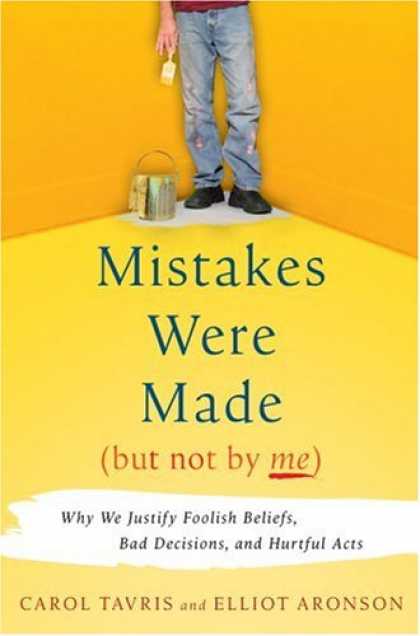
mistakes-were-madeI just down loaded Mistakes Were Made (But Not by Me) to my Kindle. It’s about cognitive dissonance theory and how we (people) will defend our position even in the face of compelling contrary evidence in order to protect our perceptions of self.

I am enjoying it so far. I see many areas where cognitive dissonance afflicts sales, sales leaders and entrepreneurs. This passage sums it up well:

The brain is design with blind spots, optical and psychological, and one of its cleverest tricks is to confer on us the comforting delusion that we, personally, do not have any. In a sense, dissonance theory is a theory of blind spots — of how and why people unintentionally blind themselves so that they fail to notice vital events and information that might make them question their behavior or their convictions. Along with the confirmation bias, the brain comes packaged with other self-serving habits that allow us to justify our own perceptions and beliefs as being accurate, realistic, and unbiased. Social psychologist Lee Ross calls this phenomenon “naive realism,” the inescapable conviction that we perceive objects and events clearly, “as they really are.” We assume that other reasonable people see things the same way we do. If they disagree with us, they obviously aren’t seeing clearly. Naive realism creates a logical labyrinth because it presupposes two things: One, people who are open-minded and fair ought to agree with a reasonable opinion. And two, any opinion I hold must be reasonable; if it weren’t, I wouldn’t hold it. Therefore, if I can just get my opponents to sit down here and listen to me, so I can tell them how things really are, they will agree with me. And if they don’t it must be because they are biased.

How many times do you see entreprenuers or sales people convince themselves of things. Clinging to the idea they are right, flying in the face of contrary data? This book is going to be fun. I will share passages and quotes along the way. I look forward to your thoughts and some good dialog.

SXSW And Your Online Presence

sxsw-2010A while back I wrote a post called; Online Presence – Asset of the Future: Why Social Graph Will Be Worth As Much As Your Home. It has been one of my most popular posts.

It’s a powerful post as it identifies the social and cultural change our society is going through and the impact to our personal success and well being. Simply put, in the near future your social graph will play a substantial role in determining your lot in life. Those with strong, well managed social graphs will be the new elite, those without will be at a decided disadvantage. Your social graph will be the most important asset you own, more valuable than your home.

Go Vote For US

Go Vote For US

This topic has been nominated to be a panel topic for SXSW 2010 in Austin, TX. It’s going to be a killer panel. Online Presence and our Social Graph are completely changing they way work gets done, and how we communicate.

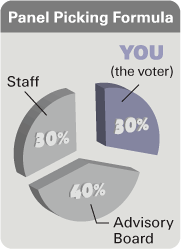
My partner Leslie Poston and I need your to make sure Online Presence – Asset of the Future is a panel at the show. The final panels are chosen by vote; 40% an advisory board 30% staff and 30% BY YOU! We need your vote.

To give us some love and make sure SXSW gets a killer panel, go here and vote and comment. The more noise around this topic the better the chances we are selected.

Thanks for the love and we hope to see you SXSW.

Control vs. Influence

We don’t control very much in the world of sales. We like to think we do. We build neat little sales processes. We have weekly, monthly and quarterly business reviews. We make commitments to the sales managers, to the executives and to the shareholders about how much we are going to sell and by when. We build fancy reports to show we have things under control. But we don’t We like to think sales can be controlled. It can’t.

We can’t control when our customers will buy. We can’t control how much they’ll buy. We can’t control who they’ll buy from. We can’t control what they’ll buy and why they’ll buy it. There is not much we can control in sales.

What we can do is influence. We can deliver “best in class” customer service to influnce them. We can create innovative, easy to use, products that deliver exceptional value. We can be easy to do business with. We can give away our products to our best customers. We can be responsive. We can listen. We can make our customers our number one priority.

We can’t control very much in the world of sales but we CAN influence a whole lot of things.

To get the results you want, focus on what you can influence, not what you can’t control.

Berkshire Hathaway, and My Vacation

We are on vacation this week on Cape Cod. We are staying on Great Island with my friends from college. Great Island is a small private island in Yarmouth. It’s a beautiful place across the harbor from the Kennedy compound. It has been in my friends family, the Chace’s, for generations. It has great history as does the Chace family. I’m big into family legacy.

Great Island, Point Gammon Lighthouse

Great Island, Point Gammon Lighthouse

The Chace story goes back to Oliver Chace in 1839 with creation of the Valley Falls company, a textile mill. By 1955, the Valley Falls Company had acquired a number of additional textile mills and including the Berkshire Fine Spinning and the Hathaway Mills from Horatio Hathaway, thereby creating Berkshire Hathaway. By 1955 Berkshire Hathaway, run and operated by Malcolm G. Chace Jr was generating 120 Million in revenue, had 15 plants and 12,000 employees.

The Guest House

The Guest House

In 1962 Buffet Limited Partnership, run by Warren Buffet started to buy shares of Berkshire Hathaway. By 1965 Buffet had paid 14 million dollars and took control of the company. The part of this story I like best is what few people know. Impressed with this young entrepreneur named Warren Buffet and his investment strategies, Malcolm Chace took much of the purchase price of his family business in the form of stock and held it. He went long on Warren Buffet. Adhering to many of Warren Buffets principles of frugality and common sense Malcolm Jr held his shares in Berkshire Hathaway and the family still owns the majority of the original shares they received for Berkshire Hathaway today.

Adhering to strong principles, and having the strength to bet long term, Malcolm Chace Jr. had the ability to turn an exit of his company into a giant return. Exits, in most cases are the pinnacle of return. Not so in this case. The sale of Berkshire Hathaway to Warren Buffet created the platform for Warren to grow his financial juggernaut. While Malcolm turned a 14 million dollar buyout into 100’s of millions of dollars and extended the legacy of the Chace Family.

Fourteen million dollars was a lot of money in 1965. Most people would have taken the money and run. It’s principles and vision that drive decisions few would make in the moment. Malcolm had the principles and vision to turn something smaller into something bigger.

View from Pointe Gammon

View from Point Gammon


Principles, vision, and values direct us, regardless of what they are. Without them you can never really know what you will do.

Are you a Thermometer or a Thermostat

I absolutely love this.

Seth Godin quote from Tribes:

“A thermostat is far more valuable than a thermometer.

The thermometer reveals that something is broken. The thermometer is an indicator, our canary in the coal mine. Thermometers tell us when we’re spending too much or gaining market share or not answering the phone quickly enough. Organizations are filled with human thermometers. They can criticize or point out or just whine.

The thermostat, on the other hand, manages to change the environment in sync with the outside world. Every organization needs at least one thermostat. These are the leaders who can create change in response to the outside world, and do it consistently over time.”

I see thermometers everywhere. It’s easy to be a thermometer. There is little risk. Thermostats are different. They are measured on their output. How they can change the environment around them. Like themometers, they can tell you what’s wrong, but unlike thermometers, they then actually do something about it.

Are you a thermometer or a thermostat. The world needs more thermostats.

Is Sales Changing?

I need your help. I’ve got this nagging feeling. I can’t completely get my arms around it. What it’s telling me is sales is changing. It’s telling me the days of Glenn Gary/Glenn Ross are over. The hierarchical, high pressure, churn em and burn em, contest driven, sales at all cost, steak knives for second place, a Cadillac for first place, cold calling, list buying, sales culture is dying.

A number of things are causing this pestering sense of change. More and more companies, especially startups are building B2B businesses without sales teams and are having suceess. I’m seeing established companies cut sales teams without decline in revenue. I’m seeing more increasingly complex products and services in which the traditional sales person is ill equipped to sell. I’m seeing more and more tools available to companies to engage with potential customers without the need for sales teams. There are an increasing number of ways for companies to move their products virally across the Internet without the influence of a sales team. Companies like Yammer and SocialCast have penetrated 100’s of companies, from Fortune 500 to small mom and Pop’s without sales.

Sales is changing, I know it. I see the signs all around me. I just can’t get my finger on it. What I do know is traditional sales, that legacy system of hierarchical, high pressure, transactional sales is running it’s course. Customers and clients have choices in how they want to buy and engage and they are embracing them.

What do you think? Are you seeing it too? Are we at the beginning of a fundamental change in sales? Or am I just whacked?

Don’t Kiss Your Customers Ass

The customer is not always right. Customers are wrong. They don’t always ask for reasonable things. Most of your customers are not invested in your success. Most of your customers look at you as a one way street. What can they get from you?

Just because a customer is upset, frustrated and wanting blood, doesn’t mean you have to jump. You don’t have to kiss your customers ass.

What you do have to do is listen, understand, ask questions and respond.

Respond in a manner that meets the needs of your customer. Respond in a manner meant to resolve an issue fairly and demonstrates commitment and loyalty. Respond to your customers needs. Respond in a way that is consistent with your brand. Respond with confidence.

Don’t kiss your customers ass. Don’t bend to unreasonable demands just to demonstrate they are important to you, because they’re not. Any customer with unreasonable demands is no customer worth having. Customer relationships, are just that relationships and any relationship that relies on unreasonable demands is an unhealthy relationship.

Any shrink will tell you, unhealthy relationships is no relationship at all. It’s never healthy to kiss anyone’s ass, period.

Stop Rewarding The Naysayers

It’s easy to bash things that are new or unconventional. It’s easy to say someone is wrong when it’s a new perspective. It doesn’t take a lot of guts to challenge the unique idea from the intern. It’s not hard to say something won’t work if it has never been done before.

Taking the safe side of a controversial position is easy. It’s easy because you can’t lose. If the idea or innovation fails your were right. If it is successful, no one else saw it either and so your not faulted for being wrong. We reward the naysayers.

If you want more innovation in your organization, stop rewarding the critics and start rewarding innovators, they are the ones taking the risk. Make it harder to be a critic and easier to be an innovator.

Don’t reward the naysayers.

Keep Up With Me:


Categories