Keenan 411

Think Like You Have To Defend It

I was talking to a former employee the other day. We were talking about the changing work place and the unique dynamics the down economy has created.

During the conversation he said he was getting frustrated with his new manager. He said he liked him but didn’t feel he was bringing much value. He said he asked a lot of questions, but not Jim Keenan questions. Flattered, I had to ask, what are Jim Keenan questions.

He said Jim Keenan questions challenge you to dig deep and then defend your thoughts. The questions his new manager would ask were questions he himself would ask, they weren’t questions he hadn’t thought of. They were how do we fix this problem questions, NOT what is the problem, why is it a problem, how did it become a problem, is it really a problem, is it THE problem, does it really need to be fixed and then, if so, what needs to be fixed first and why?

He said the questions didn’t help get to the heart of the matter. They just accepted what was on the table. They didn’t challenge his thinking.

What my former employee was saying, was he enjoyed being challenged. He wanted a manager to help him see more than he was seeing at the moment. He said he liked it when we worked together. We never just accepted things for what they were. We didn’t allow what was on the surface to dictate our thinking and because of this he was far more effective.

I’ve always held that being a coach is a leaders job. To be a coach means pushing your players. It’s challenging their capabilities and perspectives. It’s getting more out of them than they can get out of themselves. The best way to do this is to ask questions that challenge their thinking. It’s making them uncomfortable.

The best leaders I’ve ever had were the ones who challenged my thinking. They made me own my thoughts. It was never good enough to say what I thought. I had to defend it.

Forcing people to defend their thoughts doesn’t allow them to just grab what sounds right or quickly fits for the moment. Defending our thoughts makes us think long and hard about why we are taking a position. It compels us to do more research, gather more data, test our assumptions, and be more clear.

Challenging people to defend their thoughts doesn’t make you popular, but it definitely separates the wheat from the chaffe.

This former employee is proof of that, he would make some of the best bread you’ve ever tasted.

If you’re going to bother thinking, think like you have to defend it.

Taxes vs Humanity, Immigration vs Life, and The Winner Is?

My Dad would always say to me; “Get your own house in order before you worry about anyone else’s”.

This has been ringing more and more true for me as late.

It seems to me, we (Americans) have become increasingly vocal with our discontent. We are complaining about government spending, about healthcare, about immigration, about the big bad banks, about taxes, Obama, “Socialism” and more. An entire movement has sprouted up (The Tea Party) railing against what they see as social injustice and the ever growing control of the federal government. We seem to be growing angrier and angrier, demanding change and expressing our discontent with much around us. We seem to be mad at everyone; immigrants, Muslims, politicians, Democrats and Republicans alike, the President, CEO’s, the Pope, the oil companies, the media and more, no one has escaped our wrath of late.

In all this anger I think we are losing something far more important than all those things, our humanity.

A man died the other day. He was stabbed while trying to save a woman from being robbed. He lay dying on a New York street for almost two hours while as many as 25 people walked by. Some took pictures, others rolled him over saw blood and left. No one extended him the help he extended to the woman who was being robbed.

Have we become so self-absorbed we have abandoned our commitment to help thy neighbor? In our race to accumulate material things, do we no longer embrace the good Samaritan in ourselves? Is community now defined as those we know, those closest to us? Are the strangers who live next to us, or down the street, or even in the ally less valuable because we don’t know them?

Hugo Alfredo Tale-Yax was an immigrant from Nicaragua. He was homeless. A woman was being mugged. He knew what to do. He tried to help and we left him to die in the street. It’s sad. We are better than that.

Do we need to address government spending. Yes. Could we have better representation in Washington? Yes. Are healthcare, immigration, the economy, education and the environment important? Yes. They aren’t, however, as important as our own humanity.

We seem angry these days. I can’t help but wonder if it’s missed placed anger.

What do we have to be so angry about? Are we not surprised no one would help Hugo and that scares us? Are we subconsciously aware of a diminishing lack of empathy in our country? Is our anger rooted in the feeling we are loosing parts of our humanity? Do our fears mis-guide us? Do they create a miss-placed anger?

Hugo had the right value system. He tried to help. What about the rest of us?

The next time we feel angry and decide to march on Washington to defeat healthcare, before we let our anger drive us to join the Tea Party or the NRA, or ACORN, we might want to take a look a little closer to home. We are this country. You, me, and Hugo. We get to make a difference. The values we embrace are ours to enforce. We have the power through our interaction with others to make change. Yelling out of anger to get OTHER’s to make a difference only moves us further away from one another. Yelling out of anger for others to fix the problem doesn’t absolve us of responsibility. We only think it does.

Only a week after Arizona passed a strict illegal immigration bill to keep illigal immigrants out of this country, an illegal immigrant saved a woman’s life. This illegal immigrant demonstrated the values the American citizens who walked by as he bled to death, couldn’t.

My dad was absolutely right. We need to get our own house in order before we worry about anyone else’s.

Defense is No Offense

I’ve been hearing the phrase, “Thats not the way we do it here” a lot lately.

This phrase is used to defend against change. It’s our way of avoiding having to change or embrace an alternative.

The problem with defending what we do, is it keeps us from doing something new. It keeps us from having to change.

To change we have to look at doing things differently. We have to accept that what we’ve been doing may no longer be in our best interest.

This is hard.

Change opens us upto failure. It forces us to take a position. Taking positions exposes us to criticism and critique and that makes us uncomfortable.

To keep from being criticized and being uncomfortable we defend.

Defending wastes productive energy. It takes our focus away from improvemet and growth.

When we are on defence we’re not on offence.

The 2010 Social Media Marketing Industry Report says 90% of marketers use social media for marketing. What are the remaining 10% doing? They are defending. They are too busy explaining why their business is different and social median doesn’t apply. They are too focused on defending their current marketing approach rather than trying to improve on it.

Rather than be on the defensive, go on the offensive. Do “it” different. Take risks; fail. Pretend the status quo doesn’t exist. Ignore the defenders. Look forward.

Being on the defensive only keeps you from failing, it never wins. Being on the offensive, on the other hand, is how you win.

Now go win.

Rules

Rules are good when they make the game better. But, if they change the game they’ve gone too far.

Too often we focus on making rules and lose site of the game.

Companies do this. They start making rules. The rules begin to change the game. Overtime, everyone starts focusing on the rules, and forget what the game was.

If your losing customers, if the competitors are gaining, if the status quo is constantly defended, if innovation is stifled, then the rules have changed the game.

Don’t let the rules change the game.

Be the person that MAKES the rules make the game BETTER!

Personal and Informal

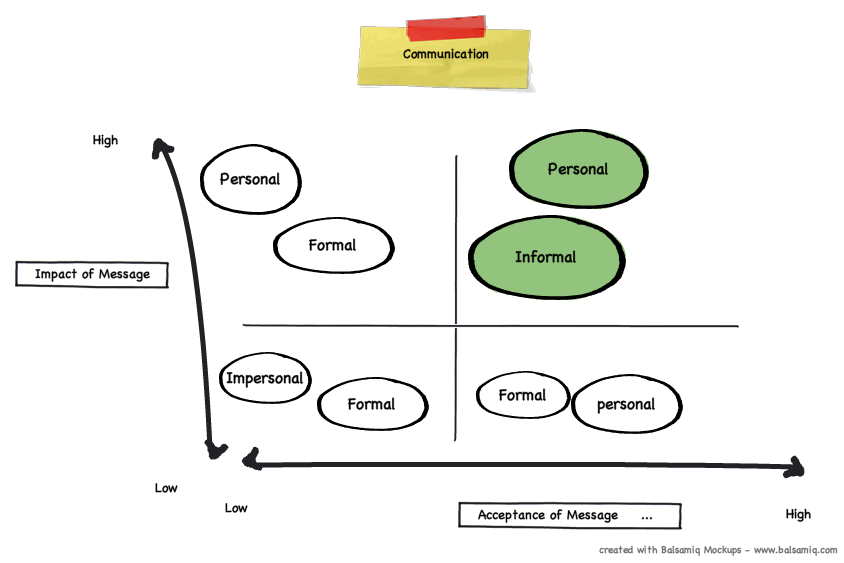
If personal and informal communication is the best way to get through to people, why do we continually send out formal, impersonal messages?

Why do companies still send out stiff, formal PR messages? Why do they still rely on a formal, sanitized messages sent via email?

We don’t respond to informal, impersonal messages. People want to feel talked with, not to. People want to engage. They want to be apart of the conversation, not on the sidelines.

The tools exist.

Social media makes it easier for companies to create and engage in personal, informal conversations. Enterprise 2.0 makes it easy for the CEO to have personal conversations with the entire company. It’s now easier to create messages that resonate.

The goal shouldn’t be to communicate. The goal is to create action. Action only happens when the messages have impact and stick. Formal, impersonal messages don’t have impact and don’t stick.

Why do we still communicate formally? Why are messages still impersonal?

If you want to get your message across, make it personal, and relax. They will hear you.

How does your organization communicate?

I Should Have Listened to Brad Feld!

Facebook launched it’s new services at f8 this week. The new service allows you to share the things you like and see on other websites with your Facebook friends. The service is designed to spread Facebook’s tentacles across the web. I think this ideas has merit. There are a few challenges and a few flaws, one being the fact that many of us have different social graphs, and a one size fits all doesn’t work. Fred Wilson talks about this challenge in his post today.

I am a huge fan of sharing and promotion sites. Sharing is at the root of promotion, so I combine the two. I see Twitter and Facebook being as much about promotion as they are about sharing.

About 3 years ago I started a sharing and promotion social networking company called cre8Buzz. I’ve talked about here before. The cool part of the site was everything users uploaded was ranked and rated based on passive and active voting. Every picture, video, blog post, music file and user profile was ranked and rated by category. The idea was the best and most relevant content based on user preference would be high-lighted and easily shared with others. Inspite of it’s demise, I am still bullish it was a great concept. Too bad I butchered the exectution.

One of the places I butchered the execution was in its closed nature. We only rated and captured media and data our users uploaded.

In my “pitch” to Brad Feld of the Foundry Group, he asked me why we were only focusing on the content users uploaded? Why weren’t we rating and ranking the content across the web? He said too many sites were already capturing the data; YouTube, Facebook, Myspace etc. Brad suggested it was too big a barrier to ask people to do it again. He was right!

cre8Buzz had some good momentum early. Our value proposition was solid. The rankings created tremendous competition. The ratings and rankings got great exposure for people, their blogs and cool media. Regardless of the traction, we were too tied down and struggled to keep the growth going.

Facebook just launched a close version of what Brad suggested cre8Buzz do. We were well positioned to do what Facebook is doing. We could have done it earlier and better.

I should have listened to Brad.

I love the concept of sharing. Sharing is at the core of human nature. Society, communities and individuals ALL win when information is frictionless and moves through the network quickly. Facebook’s move here is a good one. It increases the value of collective data and information. It’s another vehicle to ensure the best stuff is found and shared and that’s good for everybody.

Well, except cre8Buzz, because I was too starry eyed with my own ideas to hear what Brad was saying. If I had been more perceptive, maybe Facebook would have just purchased cre8Buzz to roll out this new feature.

As a friend of my always says – If, “ifs” and “buts” were candy and nuts . . . everyday would be Christmas.

It’s Not What You Think, It’s What I Think

My electric company called me yesterday. They started with; “This is not a sales call.” It was. They lied to me out of the gate.  Not a good start.

They were calling to get me to allow them to put a monitoring device on my air-conditioner. It would give them control over my AC and on hot days they would shut off the blower. The objective was to help them better manage power usage during peak times.

Their value proposition was the following:

  1. a $40.00 credit each fall on my bill
  2. It is good for the environment
  3. It helps keep energy costs low for everyone.

All good reasons, but not enough for me.

My wife is a stay at home mom.  We have 3 kids under 4.   I don’t want to risk a heat wave, where my wife and the girls are stuck in a sweltering house because the A/C blower has been shut off for two hours.  So, I said no thanks.

In response, the rep blurts out: “You don’t care about the environment?”

I do care about the environment.  But, based on what’s been explained to me, my wife and daughters comfort is far more important than the 500kw’s were going to save by shutting of our A/C for a couple off hours a month.  If you have 3 under 4, you get the critical nature of their comfort.

I like to have fun with sales people. Despite my no,  I let the rep know that her approach of attacking me, as not being environmentally conscience ,was NOT the way to get me to change my mind.

I gave her this advice.

After someone has heard your pitch and says NO, simply ask them why they don’t feel the program is for them.  Don’t “tell” them another thing. Just sit and listen.

To drive home the point and give her another chance to sell me, (I wasn’t adamant about not letting them do it,  I needed to be convinced it wouldn’t affect  my families comfort) I shared with her my concerns for the comfort of my family on hot days.  I was very specific.  I served up my objection like a giant softball!

Do you think she took it?

Nope!

She went right back to her 3 scripted value propositions; cheaper energy, 40 bucks and good for the environment. She couldn’t get away from the script.  She couldn’t think for herself.

I tried twice to get her to bite.  She didn’t and I didn’t change my mind.  Excel energy wasted another call.

When a company creates a product or offer, it makes assumptions about it’s value.   But, no matter how thorough it is in identifying the most compelling value propositions, the market will always tell you what the true value is.

For me it was, can I accomplish all those things you promise without a change in my comfort level.  If the answer is yes, sign me up.  If you can’t give me my comfort, the other 3 don’t matter.

The Xcel Energy rep just didn’t get that.  She was convinced she knew what I wanted, the script said so.

Not Just How Much but When

Conventional sales asks; how much is the deal worth? How much did you sell? Most sales people and organizations are fixated on how much is sold and justifiably so. The more that is sold, the healthier the company, the stronger the sales team. How much is an important measurement.

There is another measurement I think needs to get more attention than it does. It’s “when” is it going to be sold.

In sales it’s not good enough to know how much you are going to sell, it’s also important to know when you are going to sell it.

Being able to accurately predict when a sale will close is part of the science of sales. The most successful sales people are good at this and they make a huge impact on an organization.

Organizations need to manage cash, revenue, product deployment, inventory and more. Sales prediction plays a hug role in the success of all of these. Without accurate sales predictions companies are often left scrambling to deliver, face inventory issues, miss Wall St. projections and more.

I don’t see enough focus on the predictability of sales. I rarely see teams or individuals measured on predictability. On the “carrot” side, I can’t say I hear sales people lauded for their accuracy. It doesn’t happen very often and it should.

I think every sales person and sales team needs to commit to their numbers. Every quarter they need to tell the organization how much they are going to sell. They need to commit to a monthly number and a quarterly number and standby it. At the end of each quarter commits should be reviewed for accuracy. Who go it right? Who missed it?

Measure the people and teams on how accurate they are and rank them. It’ll provide great insight into who knows their business and who has command of the sales cycle and who doesn’t.

Good sales people make their number. Great sales people make their number and accurately tell you when they will do it.

It’s not good enough just to know how much, you need to know when.

How accurate are you?

Reblog this post [with Zemanta]

Risky Decisions

Risky decisions which are successful are consider genius.

Risky decisions that fail are considered foolish.

Critics rarely review what happened in the beginning, just what happened in the end.

Don’t worry about the critics. Take good risks and move forward, be fearless.

Remember: the critics are the people without the ideas. Critics only matter AFTER the fact and by that time – they don’t matter.

Opportunity and My Feed Reader

I’m an opportunist. I see opportunity in everything; no matter how big or how small.

My brain works like this; information in, process, then ask what advantage, result, benefit is there in the info? It’s always on.

Thinking this way has been great for business. It allows me to navigate very complex environments. It also helps my customers because it’s transferable. I help them see their opportunites.

The down side to being an opportunist is fear. I am often afraid I might miss an opportunity.

This is where my feed reader comes in.

My feed reader is packed with blogs, 100′s of them. Each one was added because I saw an opportunity in it; an opportunity to improve sales, strengthen my team, find good investments, innovate, meet cool people, and more.

Packed with 100′s of blogs, I can’t get to them all, so I’ve decided to pare it down. To someone like me this is hard. As I determine which to save and which to delete I am reminded why I saved the blog in the first place. There are some good blogs in my reader. This is why it’s hard. I don’t want to delete the blog that could give me that perfect piece of information, the one that is behind the next great opportunity. This is all inspite of the fact I don’t find time to read 90% of the blogs in my reader in the first place.

I know this is silly. It’s just how my mind works.

To get over it and hit delete faster, I’m looking at a thin, streamlined, feed reader as an opportunity, as a way to read more blogs, not less.

All the information in the world does no good if you don’t read it. I ain’t reading much in my feed reader these days. It’s too full and for sure that’s lost opportunity.

Delete . . . ahhh that wasn’t so bad.

Keep Up With Me:


Categories

  • Asset of The Future (24)
  • Business Performance (118)
  • Career Development (33)
  • Customer Service (38)
  • Economy (10)
  • Enterprise 2.0 (22)
  • Entrepreneur (16)
  • Hiring/Firing (23)
  • Leadership (100)
  • Marketing (17)
  • My Reading Quotes (8)
  • Personal Brand (27)
  • Personal Development (75)
  • Politics (12)
  • Random (47)
  • Sales Process (71)
  • Skiing (5)
  • Strategy (2)
  • Sunday Morning Blog (18)
  • TalkShoe Events (5)
  • Technology and Products (7)
  • The Chase (104)
  • To the Community (1)
  • Uncategorized (63)
  • Web 2.0/Social Networking (78)
  • What I Think! (132)