
banner

The Sales Stack

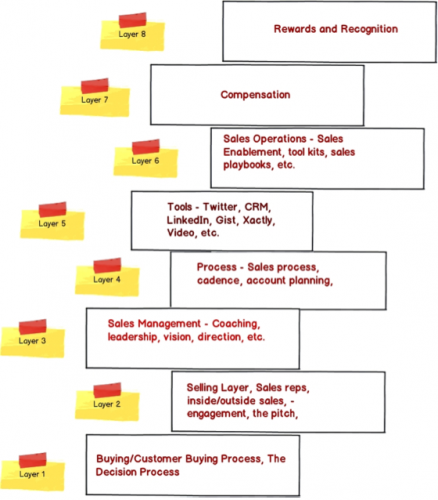
I’ve been kicking around the idea of a “sales stack.”  Similar to the OSI model of computer networking, the sales stack is designed to create logical layers that articulate how the full sales environment is connected and comes together.

Creating a “sales stack” allows sales organizations to logically break down the unique elements required to effectively deliver revenue. Each layer in the stack impacts the layer above and below it. The stack gives sales leaders a clear framework from which to evaluate their sales organization and the sales process to effectively develop selling organizations.

This is my first crack. I wanted to get this communities thoughts.  What do you think?
 

Questions -

  1. Does it even make sense to have a sales stack?
  2. Does this represent the entire sales stack?
  3. Should something be added or taken away?
  4. Is the order correct?

Share your thoughts in the comments. I’m looking forward to how this community improves on this.

I’ll incorporate the changes and publish them here.

  • http://www.partnersinexcellenceblog.com/ Dave Brock

    Jim:  I certainly believe a sales stack exists, though I would tend to have one that looks very different than your—so you’ve given me an idea for a blog post.  I think there are two capstones for the sales stack:  The target customer (what they buy, why they buy, how they buy), and the Company business strategy and priorities (since it’s the responsibility of sales to execute the strategy in front of customers.  All the other elements are in between.

    I think compensation and incentives are important elements of a sales stack, but, for example, probably less important than sales process/execution, people selection, etc.  So the biggest change I would make is to reposition this.

    I think the sales stack also changes based on your point of view–an individual contributor, a first line manager, a sales executive.

    I’ll write my own version and let you know.  Thanks for giving me the idea!

  • http://asalesguy.com Keenan

    David,

    Very interested in what you come up with. Please let me know when your done.
    Also, from what I can interpret from your comments, we may not be that far off. The flow of mine is from the bottom up. Layer 1 to layer 8. Therefore we see the customers buying process (what they buy, why they buy, how they buy etc.) as the key or critical element to the stack. That’s why I put it on the bottom, it’s the foundation. Everything moves up from there. ie: Company business strategy, sales execution etc come next.
    I like your more descriptives and holistic descriptions as well. I will add those. Ex: The customer buying process IS more than just HOW they buy. Company businsess strategy is more than the sales folks. I like David.
    Thanks man

    Looking forward to your post.

  • http://www.odonnellweb.com/blog/ Chris O’Donnell

    I think the product or service has to be in there somewhere. It doesn’t matter how good you may be at all that other stuff, if your product sucks, or just doesn’t meet a need anybody is willing to pay for, all that other stuff is sort of pointless.

  • http://twitter.com/Mike_Kunkle Mike Kunkle

    Hey Jim, first, before I tell you my differing thoughts, I want to say that like your thinking that there are various elements at play which contribute to organizational sales success. As a friend of mine says, I believe this is “directionally correct,” or headed in the right direction.

    In my work and research I call these elements “performance levers,” which I define as “any knowledge, skill, behavior, or conditions that must exist for ethical, sustained, high performance to occur.”

    Having said that, I don’t think it’s a “stack” or layers, per se, and I don’t think the elements are 100% consistent for every business. I also think you are lumping a lot of things together in the layers. I see them more like cylinders of a car, circled around an engine. You might have 20 standalone cylinders in general, but as an example, perhaps only 8 are truly required for ethical, sustained, high performance in a particular company or industry.

    In my experience, I’ve seen performance levers at play at various levels: 1) the organizational or company level, 2) a department or function level, 3) especially at a position or role level, where even 4) tasks come into the picture (although tasks are a subset of position). Companies achieve the greatest success when there the individual engines (performance levers) are tuned to fire together at each level (org, department, role, tasks), with alignment across all levels (so they are “driving in the same direction”).

    Yes, I fully realize that this is *way* more complex than most execs, especially sales execs, want to think about, and usually it’s only the performance geeks and Peter Senge fans who don’t fall asleep somewhere after the words “performance lever.” But I contend that true high performance happens by lucky circumstance, or by people getting enough things aligned to make a difference – even if they don’t know exactly what they’re doing, or by true intention and purposeful organizational development. Personally, I prefer the latter, but I seem to be in a vast minority.

    So, coming full circle, you may be smarter than me by getting it down to something this simple. But by all means, please add Proactive Sourcing, Magnetic Recruiting and Effective Sales Selection (although if you use those words exactly, I’d appreciate a nod), because it is often the single most important thing a business can do to radically improve sales results. Right people; right seats. You also don’t have to read many of my blog posts to realize that I think sales management is actually more critical, but only because you will only ever higher a certain percentage of top sales performers (although even they improve with great training and field coaching).

    Oh, and to Chris’ point on product, I agree. For me, that would be an Organizational Lever. If the product does not meet a need in the marketplace, and hopefully in a *compelling* way, and the marketing product managers are not talking to customers and working fervently to fix that, exit the Titanic on a lifeboat while you can. ;-)

    Hope this offers at least something that might help.

    Mike Kunkle

    LinkedIn: http://www.linkedin.com/in/mikekunkle
    Twitter: https://twitter.com/mike_kunkle
    Blog: http://neuronnexus.posterous.com

  • http://twitter.com/tamaraschenk Tamara Schenk

    Jim, that’s a great idea and a challenging disussion!
    Thanks for bringing this up!

    Mike and Dave made already very valuable and insightful comments (looking forward to read Dave’s blog post on that!) and Chris adressed an issue that came also in my mind: to integrate service. which has to to with the question of the general scope of such a stack.
    I’d like to go one step further and to think about a SELLING stack, not a SALES stack only. A succesful selling system consists of much more than sales as a function and it’s also much more than the sales and marketing alignment discussion, it’s about the whole sales support supply chain. I think, the layers of strategy, process and systems (both internal and social tools, and mobile!) are important. But where do they focus on? On scalable efficiency, on scalable performance which is of course the foundation of what you want to describe.
    What makes a difference later on, is how a selling systems makes a difference and that’s about collaboration across the selling system and with clients, it’s about talent, coaching, skills, people, incentives, comp plans, and so on – I’d say, that’s a layer of scalable learning.

    Thoughts?

  • http://twitter.com/Mike_Kunkle Mike Kunkle

    Exactly, Tamara. Have you seen this? http://slidesha.re/PerfLevers082011 ? And even my model in that version isn’t complete. It’s just the most I’ve ever been able to convince an employer to focus on (probably my greatest shortcoming – getting others to understand it all). It’s really about all of the pillars being in place and aligned… a living ecosystem of sales and supporting elements.