Keenan 411

Why People Don’t Get Social Networking

I was talking with someone the other day about Twitter and the importance of building a social presence.  Their response was, they see how it is important for some people, but for his line of work, it won’t work, especially Twitter.  He had an array of reasons why Twitter, Blogging and Social Networking can’t help him.   His business is too specialized he said.  It’s not going to get him any more business than he already has.

He’s probably right.  But thats not enough of a reason not to build an online presence.  It could get him a new job in the future, it could create a relationship he may need to close a deal someday, it could get him information he needed that he DIDN’T know existed.  It could do a lot of things he is unaware of today, that could help him in the future.  He is not alone.  His thinking is like that of most people I talk to who aren’t actively building and online presence.  It’s too linear.

The problem isn’t him but humanity.  We are purpose driven.

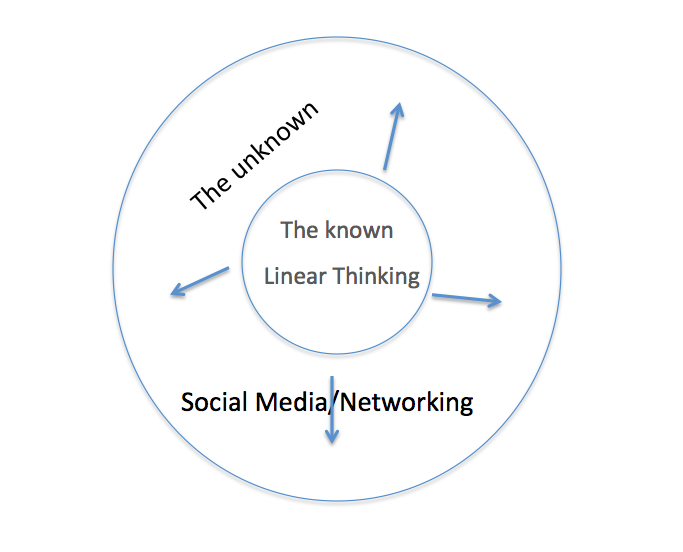
Since the cave man days our actions have been purpose driven.  If you wanted something from the guy across the cave you got up and took it from him.  If you were hungry you went out and killed some food.  Over the years we became more civilized, but we were still purpose driven.  If you wanted to talk to someone you sent a letter.  If you wanted a job, you applied for it.  Then the phone and T.V. came along.  Still driven by purpose, you knew who you were calling and why and we knew what we were going to watch on TV and when.  Communication has rarely,  if ever, been done without a direct purpose.  Everything was linear.  We played in the known.

Social media and social networks play in the unknown.  They aren’t linear.  They aren’t purpose driven.  When we tweet something, we don’t know who we are tweeting or if someone is even their to receive it.  When we blog, we don’t know who is going to read it, or who is going to comment.  We don’t know if people will like it or hate it.  We put our stuff on LinkedIn not knowing who if anyone is going to find it.  Social media is anything but purpose driven.  It’s this reason most people don’t get social media. They are thinking from the linear brain we’ve all been indoctrinated with.  If doing X doesn’t get me Y right now, I don’t have time.

Social media and social networking don’t work in a linear fashion.  They operate in a broader, less confined manner.   Users have to be OK not knowing, not getting what they want right away and able to handle getting what they didn’t expect.  Social media and social networking give life to the phrase; we dont know what we don’t know.

Many people see it as a waste of time.  To the linear mind it is.  It’s not like a phone call or and email.  It’s not like getting up and walking across the cave and getting what you want.  What it does do, quite often is give you what you didn’t know you wanted and many times that’s far more valuable.

It’s easy to focus on getting what you want and thinking in a linear fashion.  It’s measurable.   It also requires you block everything out.  Social media and social networking are different, they get you what you didn’t know you wanted and that’s a big deal.

Social networking and social media expand your world.  They make you more accessible, they provide more information, they extend your influence.  If those aren’t reason enough to “get” social media it must not be linear enough.

Social media and social networking have a place, it’s just going to take time to change 10,000 years of thinking.  It’s time to get out of the cave.

Enhanced by Zemanta

I Bought my Daughters Names

I didn’t actually buy their names, but I did buy their URL’s.  I got them from Go Daddy.   I bought my first two daughters last year and my new daughters this past week.  I bought them for 10 years.  That was the longest I could tie them down.  It cost about 100 bucks for each name.  Not too bad in the scheme of things.  I think literally owning our names will be quite valuable soon. As identities online become more and more pervasive, owning the URL to our name will be an important element in managing our online presence.

I’ve talked about it before.  The most valuable asset we will have in the future will be our online presence.  It will act as an enabler to much of our life including; the schools we go to, the jobs we get, the person we marry and more.

There are a lot of things parents are responsible for with kids; education, values, safety, etc.  I’m adding one more to the list and it’s buying their names, literally.

Enhanced by Zemanta

Twitter Power

I don’t know why I am constantly amazed at the power of Twitter (or I should say social media in general) but I am.

Twitter has been a fantastic tool for me and today was no different.

Yesterday I suggested (on Twitter) that I saw no reason the new IPad 3g shouldn’t have text messaging. Someone saw my rant and suggested I use Google Voice. I’ve been considering playing around with Google Voice for a while, so I thought this is as good a time as any.

Not having an invite I Twittered a requests for one. Within 5 min. I had a bunch of people who had an invite for me.

You just couldn’t do this a few years ago.

I am fascinated with the new level of connection and collaboration social media enables. It is truly an asset to those who take advantage of it.

Thanks to all my Twitter followers who offered up an invite to Google Voice. I’ll “talk” to you soon!

Union Square Ventures Proving-Online Presence IS the Asset of the Future

Twitter and Foursquare investor Union Square Ventures is hiring two associates and by doing so are proving the point that an online presence is the most valuable asset we can own. I’ve been making this point a lot over the last year. Our online presence will become the most valuable asset we own, even more valuable than our home.

To find candidates USV blogged about the openings on their website and Fred Wilson a partner in the firm posted about them on his blog. No recruiter, no Monster.com postings, no 3rd party sourcing. Just two blog posts. USV and Fred have built a huge following. They already had an audience.

I have no visibility into how many applications were submitted, but if the number of comments is any indication, it’s over 100.

What really makes this interesting is that USV asked candidates for just 3 things: a link to their LinkedIn profile, a way to be contacted and a cover letter. They asked the cover letter contain nothing more than links to the candidates online presence. That’s it. No resume required.

USV is using online presence as the key criteria to identify the ideal candidates for their next associates. I love this idea. It’s a heck of a filter. Anyone who hasn’t taken the time to build their online presence is automatically filtered out. No need to reply. Harsh, but it’s where things are going.

What I like about this approach is it focuses on what what the candidates do, not what they say. It’s hard to B.S. your way around an empty Twitter and Facebook profile. You can’t “hide” the fact that you don’t have a blog or haven’t posted in 6 months. By focusing on applicants online presence, USV will have amazing insight into how candidates, think, write, interact, engage, and collaborate. An online presence is a living resume that doesn’t lie.

I think USV is going about this the right way. You can learn a lot about someone by following, reading and engaging with their online presence. An online presence isn’t a polished document with an agenda like a resume and that is exactly the problem with resumes. They hide as much as they share. Watching and engaging with someones online presence is the closest thing to be a fly on the wall. You get to see the real person.

If you don’t have an online presence, you’re not going to a job with one of the most prestigious venture capital firms in the country and that is too bad, because you could be a wonderful fit for them. If you are one of the lucky ones who is hired, your online presence catapulted you into the exciting and lucrative world of venture capital and that is worth something.

How much is an online presence worth? In this case it’s worth 2 years at Union Square Ventures; investors in Twitter, FourSquare, Disqus and more of the Internets hottest properties. That’s worth a lot.

USV will not be the last company to hire this way. More and more companies will use an online presence in their hiring decisions.

An online presence will be the most valuable asset you will own. Start investing!

Reblog this post [with Zemanta]

Asset of the Future-Craig Newmark Style

CraigsList founder, Craig Newmark, has a great post up today called Trust and Reputation Systems: Redistributing power and influence.

It’s a great post re-affirming what I’ve been saying on this blog for over a year. I’ve dedicated a page to it. It’s that important. Our online presence will be THE asset of the future.

His quote on the influence of social networking tools is powerful:

People use social networking tools to figure out who they can trust and rely on for decision making. By the end of this decade, power and influence will shift largely to those people with the best reputations and trust networks, from people with money and nominal power. That is, peer networks will confer legitimacy on people emerging from the grassroots.

Our networks are moving online. Our weak-tie networks are expanding. The tools to measure and quantify our networks are readily available. Trust, power, and influence will be at the core of these networks and those with the best networks will be the winners.

Soon it won’t be OK NOT to have a strong online presence. It will be too difficult to compete.

Craig is spot on when he says:

This shift is already happening, gradually creating a new power and influence equilibrium with new checks and balances. It will seem dramatic when its tipping point occurs, even though we’re living through it now.

He’s right!

It will be even more dramatic for those who wait for the tipping point.

Start investing in your online presence and brand NOW! Like any good investment, it’s best to invest early as it takes time grow and have the best returns when you get in in the beginning.

Reblog this post [with Zemanta]

Learning to Share

Sharing takes effort. I’m not talking the about the type of sharing we were taught as kids in kindergarten, but the new sharing we do online. I’m starting to notice those with the strongest online presence are good sharers.

Sharing on sites like Facebook, Twitter, LinkedIn, or on your companies microblogging site like Yammer or Socialcast is different. It’s not an action we were brought up with.

Traditionally, sharing meant sharing”BIG” things; births, deaths, graduations, weddings, etc. We knew to share the big events, the momentous occasions. We shared mostly the big stuff because sharing was so hard. It was too cumbersome to share the small stuff. Sharing meant multiple phone calls, or a mini-letter campaign. Sharing with lots of people was difficult and time consuming. So we did it mostly for the big stuff.

We did share the little stuff, but only with a small group of people, our mom’s and closest friends, and family. We did one person at at time, by phone, or occasionally by letter.

Things are changing. Sharing the little stuff is a lot easier now. It’s a quick Twitter, Facebook, or LinkedIn status update from your phone or your computer. It takes 5 minutes, yet 10′s, 100′s or even 1000′s of friends and family can experience it. Sharing is different today.

Our sharing habits have been shaped over generations around the “BIG” stuff and social media requires the little stuff. Most of us don’t know how to share the little stuff. It’s uncomfortable. It’s foreign. It doesn’t seem to matter when compared to the big stuff, yet it does. In many ways, it matters more.

Sharing the little stuff builds relationships overtime. The little stuff is more intimate. It’s more personable. The little stuff is much better at creating what is most important; relationships, groups with common interests and connections.

Learning to share today takes effort. It requires we are more conscience of our thoughts. What we once saw as a fleeting observation, is now a potential idea, or thought that can be captured and shared. Learning to do this takes work. Learning how to capture our fleeting thoughts and perceptions and remember to share them is not easy.

Social media is changing how we engage. It’s challenging traditional notions of sharing. It’s asking us to share the little stuff, not just the “BIG” stuff.

We are going to need to learn to share. We need to share the little stuff, not just the big stuff. We need to be more present with our thoughts and observations. It will be critical. Our networks are moving online. They are getting bigger. They are playing a bigger role in our success, at work, at home, in our finances and more.

Sharing is going to be at the core of the asset of the future: our online presence. Sharing just the “BIG” the stuff isn’t going to cut it.

The Future of Personal Online Branding

What do you use to promote YOU to potential employers? Could you compete with Gonglue Jiang and this?

Everything we do will flow through our online networks. Our ability to gain “reach” via our online content, and interactions will be the difference between success and failure. One of the key components of this is creating compelling content that makes people want to share it.

Stowe Boyd blogged about one of Gonglue’s innovation’s, which is now getting tons tweets, which in turn is driving tons of traffic to his page, which in turn is getting him lots of exposure.

Does your resume do that for you?

Gonglue Jiang has one of the best example of this I’ve seen yet. Imagine being a tech recruiter and landing on his page. It almost becomes a no brainer.

If your still relying on your resume to promote yourself, you are clinging to a dying process.

We all need to ask ourselves. How are we promoting the business of “US?” Is it compelling?

It needs to be. It’s going to be the biggest asset you own. It’s going to be the asset of the future.

Side note: I can’t think of a more compelling reason to learn to code.

Reblog this post [with Zemanta]

How Much Is Your Name Worth?

Ten years ago I tried to buy my last name, keenan.com Another Keenan owned it. He refused an offer of $5,000. I wouldn’t pay more for it. He has since sold it to a company called Keenan. I suspect I will never own my last name. That bums me out. Jim Keenan is also owned by someone else, although it’s an individual. I suppose, for the right price, I could have jimkeenan.com.

I don’t own my name and I don’t like it.

I think it is critical we own our online brand and that includes our names. I have bought my two daughters names and will be buying my, soon to be arriving, third daughters as well. I am securing their Facebook pages, their Twitter accounts and more. Will they use them? Who knows? But if they do, they will have their names.

Names are becoming a market. We can share names offline. We can’t share names online. User names and web domains are acquired on a first come, first serve basis. Once gone, they are gone forever. Depending on your name it could be very expensive to get after the fact. If your name is John Williams, expect to pay big. Deshawn Breznican, on the other hand, will probably be available for a while.

In a world were our online presence is the biggest asset we have, owning our names will be one of the critical investments we’ll need to make.

Have you invested in your name yet? The longer you wait, the more expensive it will be.

I wonder if we will see more Deshawns, Chantels and Matravius’s in the coming years. That would certainly solve the problem.

If I can’t get jimkeenan.com maybe I’ll change my name. How many Matravius Keenan’s can there be?

25 Reasons Your Social Graph Will Matter

If you’re a regular reader of this blog, you know what I think of an online presence.  I believe it will be the most critical asset a person owns.  It will be the asset of the future. It will be worth more than any other asset you have.  If I haven’t convinced you yet, maybe this will get you there.

Your online presence will matter because;

  1. Social media creates social capital.  Social capital is a predictor of income and wealth
  2. Gen Y will out number baby boomers by 2010, 96% of Gen Y has joined a social network,
  3. Social Media has overtaken porn as the #1 activity on the web
  4. There are over 200,000,000 million blogs, at least 100,000,000 million of those bloggers tweet or blog daily
  5. 33% of all internet users read blogs,
  6. 33 Million Americans have rated a product, service or person using an online rating system
  7. 78% of consumers trust peer recommendations – only 14% trust advertisements
  8. 80% of employers use social media to find candidates
  9. 45% of Employers use social media to screen or vet potential candidates
  10. 35% of employers decided NOT to offer a job to a candidate based on information uncovered on social media sites
  11. 18% of employers HIRED a candidate BECAUSE of their social presence
  12. 25% of college admissions use social networks as part of the admissions process
  13. 43% of people in the US Google (doogle) a first date
  14. 12.5% of all couples married in the U.S. last year met via social media
  15. 42% of all adults have said they or someone they know has been helped by following medical advice and health information found online
  16. At lease one person, using social media, avoided highly invasive spinal surgery
  17. Those with lower social capital, have a higher mortality rate -they die earlier
  18. There are over 1 Billion Internet devices
  19. There are 6 billion internet searches on Google a month
  20. 1.6 Billion people access the web via their mobile phone – that’s 1.6 billion people a click away from info about you anytime anywhere
  21. The number of text messages sent and received every day exceeds the total population of the planet
  22. 355 Million users on Facebook
  23. Avg. time spent on Facebook: 20 minutes a day
  24. 19 Million people on Twitter
  25. 83 Million people generated some form of social media in the US

BONUS reason- Since 1985 our “core networks”, our offline networks of friends and family have shrunk by 1 person.

Personal networks are moving online.   Social capital will be created and leveraged using social media.   Social capital correlates heavy to someones overall success.  Without social capital, there is little success.   Developing and managing their social graph will be the most important thing someone can do

An online presence will be the most valuable asset a person will have, worth even more than their home.

Are you convinced?

UPDATE: Made a mistake on the statistic “50% of employers HIRED a candidate BECAUSE of their social presence” I’ve changed it to 18%. Thanks to Marty for getting me to double check stats.

Social Media, a Trend?

Most of you know how passionate I am about the increasing importance of social networks in our lives.

Social networks and our online presence will be the at the center of everything we do in future, we won’t be able to escape it.

These are some compelling numbers.

Social graphs are making a huge difference for people and companies.


The individual “Brand” will be as important and valuable as the corporate brand. How much time are you investing in you social graph?

Keep Up With Me:


Categories